Heartland
Peony Society
Preliminary
Study on Paeonia tenuifolia, its Variants and Hybrids
compiled for
SPIN (Species Peonies International Network) December 1993 by Irmtraud
Rieck, Germany
shortened
version for Heartland Peony Society, with kindly permission of the author
1.0 Morphology
-
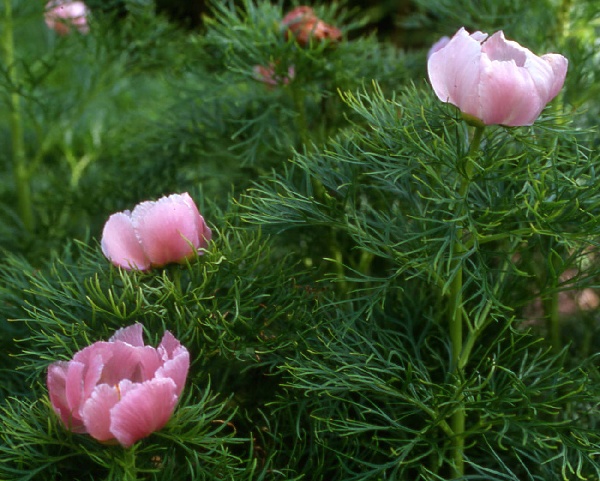
Paeonia tenuifolia
is so remarkable that it has long been known to gardeners. In 1759
it was one of the peony species identified by Linnaeus (24/126), but it
must have been known in German gardens as early as 1594 (6/64). Also
Mrs. Frank states that P. tenuifolia was raised at the beginning
of the 16th century by a nursery in London for commercial purposes (6/21).
For the English speaking world Alice Harding reports the introduction of
P.
tenuifolia in 1765 to England (9/12) and to America in 1806. (9/26).
-
-
The first P. tenuifolia
we had we raised from seed received with the name "P. daurica Krim"
(i.e. P daurica from Crimea) For years we wondered about the 'weed'
we were raising, which looked like parsley. We have lost this plant in
the meantime (after sharing it with a friend), but there is an offspring
and some red blooming children of 'Rosea' (see this below) to observe.
-
On these plants the
highest stem was 75 cm this year. The stems are glabrous,
their diameter is oblong-oval, the longer side up to 11 mm long. We noticed
9-10 leaves per stem. There were up to 5 carpels per flower. The carpels
became so heavy that the stem bent to the smaller side of the stem. Apart
from these observations, the plants match the description given by Stern
(24/110). Both the Flora of USSR(13/29) as well as the Flora R.P.Romane
(27/408) mention the rare possibility of two flowers to one stem, a phenomenon
that fascinates me because I´ve never observed it. Concerning observations
on the leaves Prof. Saunders wrote in 1931 (4/101): "I once had the curiosity
to count the points of a leaf of Tenuifolia, and there were over two hundred.
This passion for subdivisions ... does not come on the plant at the beginning
of its life, but it grows on it by degrees. ... Small weak roots, the result
of root division of Tenuifolia, will also, sometimes for a year or two,
makes leaves which show no more subdivision than do those of Veitchii."
-
-
The roots of P.
tenuifolia resemble very much the picture of the roots of P. peregrina
given in : Peonies of Greece (23/46). We suppose these "string-like attachments"
(23/45,46) give the plants the chance to be more tenacious on an unstable
talus or slope. (see also section 1.4)
-
-
In Gottlob's and
my recent studies on seeds we are presently of the opinion that the seeds
of P. tenuifolia and related forms ('Rosea', hybrida, lithophila
) have a unique shape and can be distinguished from all the other species.
The seed form is oblong oval, length up to 8 mm and breadth up to 4 mm,
the seed coat smooth, glossy and the colour dark brown. This is nothing
special, but the characteristic part of the seed is the hilum.
Compared to the size of a seed it is fairly long (2-3 mm) and lined, not
punctuated. The hilum is protuberant,
emerging about 1 mm above the small side of the seed. This year we noticed
some seeds having a suture around the seed length, giving the impression
of two halves stuck together and looking as if they had come out of a casting
mould.
-
-
Information about
colour pigments might interest some of us. Probably in 1970 F. C.
Cooper (4/143) stated that the major pigment in P. tenuifolia is
peonidin; it belongs to the anthocyanidins. He supposes that P.
tenuifolia also has some of the flavones.
-
1.1 Little known
related species
-
Since F.C. Stern's
morphology : Genus Paeonia (24), botanists from Russia, Ukraine and the
Caucasian States have identified and named several other species related
to P. tenuifolia. These 'candidate' species are largely unfamiliar
to Western gardeners.
-
Varieties of the
species
-
Stem short (-20cm).
Flowers little, with short petals (-2cm) f. parviflora Huth in Engl.
Jahrb. XIV (1871) 271. - Grows together with the type.
-
Stem higher (20-50
cm). Large flowers with petals longer than 2 cm
-
Lobule linear, 1-2
mm wide
-
Lobule lanceolate,
only some +/- linear, 3-6 (8) cm wide f. biebersteiniana (Rupr.)
N. Busch Fl. cauc. crit. III 3 (1901) 9. - P. Biebersteiniana Rupr.
Fl. Cauc. (1869) 47, 288. - District Cluj: Zaul (also
Zau) de Campie on the hill Bota (region Ludus). - Occurs together with
the type, but flowers a little later (cf. Neilr. I.c. 70). - Herbar specimens
of the university of Cluj prove this form at the "Maidens well" near Moldovita
(district Timisoara, region Moldova Naua).
-
Majority of lobules
linear, 1-2 mm wide, normally 1,5 - 3 cm long. f. normalis
A. Nyar, f. nova. in Add. page 675. - District Cluj: Zaul de Campie
on the hill Bota (region Ludus). District Craiova: Turnu Severin in Crihala
in the direction of Bresnita. District Galati: Greci (region Macin).
-
Majority of lobules
filamentous, up to 1 mm wide, half of the length of the type f.
brevifolia (Prod. et Borza) Borza Consp. Fl. Rom. I (1947) 94. - P.tenuifolia
var. brevifolia Prod. et Borza Consp. Fl. Dobr. in Bul. Acad. Stud.
Agron. V, 1 (1935) 278, Sep. pag. 106.- Basarabi (region Constantia)."(27/411)
P.tenuifolia
subsp.biebersteiniana (Ruprecht) Takhtadzjan (1966) (15/2 Cooper
p. 23,24)
-
Stern cites A. A.
Grossheim in Flora Kavkaza 1930, and mentions that besides the broader
leaf-segments there are "very short bristles along the veins of the upper
side of the leaf." (24/141) . Please compare also P. hybrida.
Both of them seem to have broader leaves than P. as well as the bristles
on the upper side. Probably these two are the same species or very closely
related in this complex, but this is just my speculation while studying
literature. "Grows on steppes and steppe slopes, sometimes among shrubs."
(13/29) The Flora R.P. Romane (27/411) describes a forma biebersteiniana
with mainly lanceolate (+/- some linear)
leaf segments of 3 -6 (8) cm breadth. It grows together with the typus,
but flowers a little later.
-
P. lithophilaKotov
sp. nova 1956 (15/3 Cooper p. 24)
-
After reading Kotov's
description one gets the impression of P. lithophila as being just
a miniature form of P. tenuifolia.. But Mr. Sahin's connections
with the botanist Nikolay Kravchuk this year brought us much more information
about the plant, some herbarium specimens and slides. In a copy of a letter
from Kravchuk/Sahin to Leo Fernig I found the thrilling sentence: "...
is daintier in all aspects and flowers in two and threes instead of the
usual one..." The slides Mr. Kravchuk took do not show one plant flowering
biflorous. The size of the plants is also hard to define, because he did
not take one picture with a person or hand or something else to be able
to distinguish the size. Until now I did not have the opportunity to see
the herbarium material Mr. Kravchuk sent, but hope to see it one day. You
will notice that the size of the seeds is as large as if it would be P.tenuifolia,
to our wonder.
-
-
Mr. Kravchuk and
his staff found P. lithophila in the Crimea: Krymskiye Gory Reserve
at places called Monastirsky Khrebet and Inzshir Sirt. At a mountain called
Chatiz-Dag on a south-east slope they collected some seeds at about 1010
m altitude. The companion plants are Elytrigia (=Agropyron) strigosa,
Festuca rupicola, Teucrium chamaedrys and Thymus callieri, all
plants that like a good drained limestone-soil. The slides show a talus
of limestones, nearly no soil to see, just rocky material. It is a pity
the slides all have a tinge of yellow, otherwise we would have offered
copies.
-
Also the Flora Romane
(27/411) mentions such a miniature Tenuifolia with the name f.parviflora.
P. carthalinica
Ketzechoveli 1959 (15/4 Cooper p.24/25)
-
No new information
so far.
-
-
The more I read about
this plant, the more I wonder about the unusual black seed colour, since
I'm assuming all other tenuifolia-related species to have brown
seeds. The picture of the herbarium specimen gives the impression of a
plant related somehow between P. anomala and P. tenuifolia
? There is another question while reading the distribution of P. carthalinica
compared to P. tenuifolia. Ketzechoveli states: P. carthalinica
"is accustomed to open ground (steppe in Georgian) while in contrast, P.
tenuifolia L. is more characteristic in oak woods and thickets."(12/11)
This is the first time I read that P. tenuifolia grows in woods
or thickets. In my mind this means shade for the peonies. All other sources
give steppes (logically, sunshine) as its habitat. (13/29)
-
-
The picture of the
herbar specimen in Ketzchovelis contribution show a plant with lanceolate
leaves, not linear ones.
P. x Majko
Ketzechoveli 1959 (15/5 Cooper p. 25)
-
Found nothing more
about it. See section on hybrids, where there is mention of a cross tenuifolia
x daurica from Fred Cooper.
P. hybrida
Pallas (24/133)
-
Stern considers it
to be a plant with no valid description: "non satis nota" (24/147). There
is great confusion about this plant. In 1800 Willdenow thought it to be
a hybrid between P. anomala and P. tenuifolia (24/129). Stern
assumes the plates and descriptions of P. hybrida in the Botanical
Register in 1829 to be a synonym of P. anomala var. intermedia
(24/133), N. A. Busch gave it in 1901 as a synonym of P. biebersteiniana.
(24/138) Nevertheless it seems the Russian botanists are convinced that
it is a species related to P. tenuifolia.
-
-
From Galen Burell
we received two different pieces of information about P. hybrida,
one in English (13/28), the other in Russian. He also shared some seeds
of it with us, received from Altai State University in Barnaul, Russia,
and they too had the typical shape that P. tenuifolia (and related
forms) seeds have. The Flora of U.S.S.R. in 1937 (13/28) describes P.
hybrida as follows:
-
-
"Perennial; thickened
roots large, short, subsessile: stems 1- flowered, 15-50 cm high, glabrous;
leaves glabrous beneath, with scarcely
discernible dense hairs above along the principal veins, biternate; leaf
lobes tripartite or pinnately parted into lobules, lobules usually pendent
(rarely not pendent), linear or lance-linear, 3-10 mm broad, acuminate
or obtuse. Flowers purple, 6-8 cm in diameter; carpels 3 or 2, densely
tomentose,
declinate; seeds black- brown. May-June." Further the Flora reports two
varieties:
-
var. tipica
Kryl. - leaf lobules linear, 3-5 mm broad, usually pendent; stems 15 -30
cm high, root cones large, short;
-
var. intermedia
(C.A. M.) Kryl. - leaf lobules lance-linear, 4-10 mm broad, not pendent,
stems to 50 cm high, often ascending, root cones elongated.
-
-
The botanists of
this Flora (13) clearly separate P. hybrida (especially var. intermedia)
from the very similiar P. anomala because of the following facts:
the seed colour is black-brown (P. anomala black), manner of growth,
and distribution in mountain-steppe areas, though not in forests (as P.
anomala ), "make it necessary to assign it to P. hybrida."
-
-
In 1931 Prof. Saunders
(4/102) gave his opinion about P. hybrida: "...the evidence is quite
conclusive that it is not a hybrid at all.... Its pollen is very active
and has none of the appearance of a hybrid pollen.... The plant is not
unlike Tenuifolia in general appearance, but the colour of the petals
is somewhat lighter, and the flowers are stalked above the leaves, so that
the plant when in bloom makes a rather better show in the garden than does
Tenuifolia."
1.2 Familiar related
variants or forms
-
A number of forms
of P. tenuifolia are cultivated in gardens and nurseries, and I
feel it will be useful to make a full list with all the information we
have available on them.
-
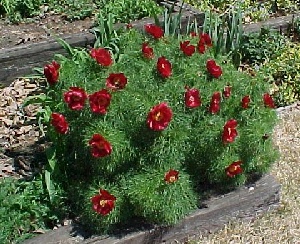
P. tenuifolia
'Plena'
-

|
-
The first Tenuifolia
we had. We received it from a local country-woman when we moved to this
village in 1975,with the strict injunction to plant it in the sunniest
place of the new garden. In this region it is quite well distributed in
farm-gardens.
|
-
J.G. Baker stated
in 1884 that it was introduced to English gardens in 1765 (24/111), thus
only 6 years after Linnaeus's description of the species. In 1825 it was
illustrated in Sweet´s British Flower Garden . Stern also cites at
the same place, it "is said to have been introduced from the Imperial Botanical
Garden, St. Petersburg." (24/133)
-
-
In our garden it
grows up to 60 cm in height. Stems are glabrous,
the diameter of a stem varies from 8 to 12 mm at the base. The stem is
roundish ellipsoid with rips along the length. On the sunny side the green
stem turns reddish. A stem has 8 to 12 leaves placed around it, but we
couldn't recognize any regularity in the twist. We compared the twisting
from one leaf to the next, and learned that it is always more than 90 but
never more than 180 degrees. The lower leaves have a greater distance to
those next above than the upper ones to one another. The petiolule of the
lowest leaf is about 6,5 cm long, the petiolule of the highest is 0 cm
(zero). It is interesting that the breadth of the lowest leaflet is less
(1mm) than that of the highest (2mm). From the first shoot that comes through
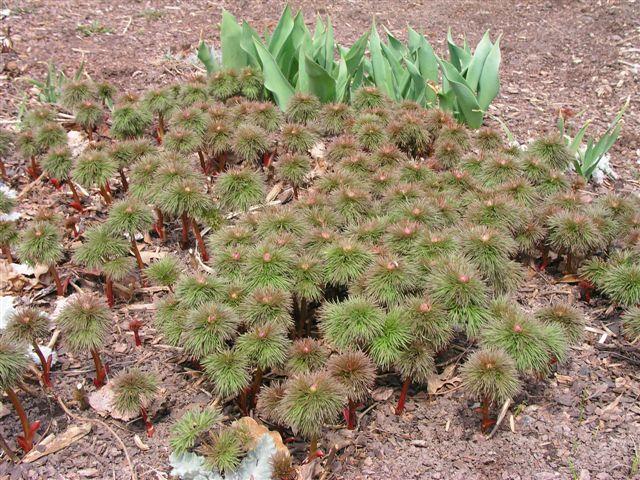
the soil one can already see the flowerbud sitting in the foliage like
an egg in a nest. The foliage is deep reddish in spring and turns to green
during maturity.
-
-
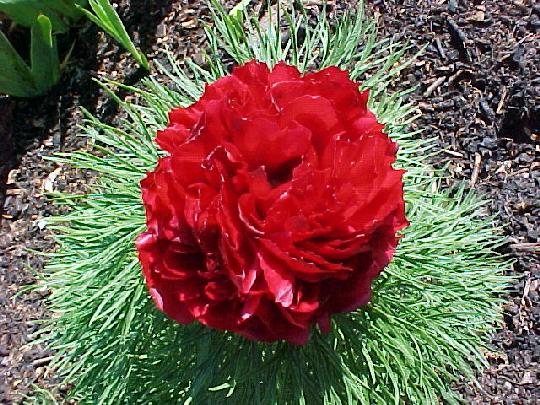
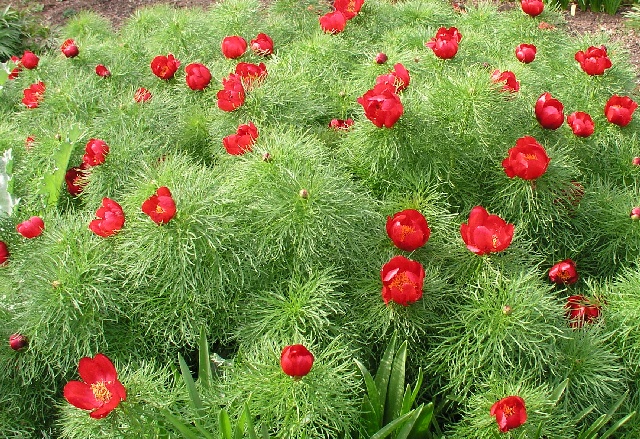
The flower is of
a shining crimson red, but we haven't yet measured the colour with the
RHS-Colour charts. It blooms some days later than P. tenuifolia.
The carpels are tomentose with red stigmas.
We never tried to hybridize
P.t. 'Plena' and it never set seeds
by natural pollination of bees. Prof Saunders reports (4/101) successful
hand-pollination of P.t.'Plena'. If it flowers during a rainy period
the stems are too weak to bear the waterfilled blossoms. Therefore it should
be staked at a pre-bloom stage. (We just tie a green string in a lasso
type knot around the whole 'bush'). After blooming we mostly cut off the
flower or pick the petals by hand because the rotten petals cause fungus
on the leaves. While writing this in September, the leaves of P. t.'Plena'
are still alive and show slight autumn colours, while the single and pink
ones already died to dormancy in August without showing any colours.
-
-
If one expects P.t.'Plena'
to increase it has to be fertilized. When we shared our plant with my parents
their plant grew much better than ours, because my father is a better feeder
than we are. Since we learned this our plants get some corns of a fertilizer
called 'Floranid permanent' 15+9+15(+2) in early spring. We take care not
to burn the shoots or leaves with the fertilizer.
-
-
The only extra work
we have to do is to cut off the stems in fall and to weed if necessary.
-
P. tenuifolia
'Rosea'
| In
1984 we bought it from the nursery Klose near Kassel. Since then we have
only been able to share it once with a friend. It shows a tendency to be
stoloniferous. This fall we tried to divide the plant a second time. After
finding the next year shoots we removed the soil like archeologists, starting
from one side and scratching around to the opposite one, as deep as about
40 cm. By doing this we learned the following: There is a main stock with
only a few stiff roots. Out off this main stock are emerging ' flexible
strings' of up to 20 cm length with no roots at all, but flowerbuds for
next year sitting at the end. There was only one 'string' starting to develop
its own root system. |
Photo by The Peony Society,
UK
|
-
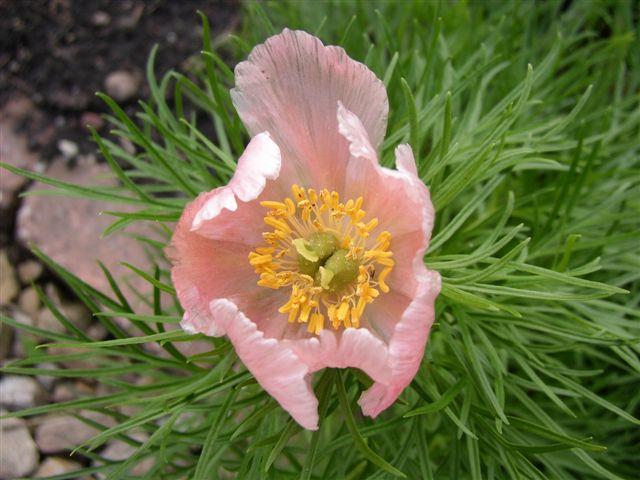
In our garden the
stems are up to 40 cm high. The diameter of a stem is 6 to 8 mm at the
base, stems are glabrous and of a light
green ('Maigrün' in german) during the whole period of vegetation.
There are up to 12 leaves to a stem. The whole plant shows the least vigour
of all the species, the stems crush easily and the leaves have a greater
tendency to catch a fungus.
-
It flowers about
ten days before P.t.'Plena', but the flower lasts about four days
only. As soon as the cupshaped flower opens slightly there are bees and
bumble-bees collecting pollen. The colour is of a light salmon and fades
to near white as the flower ages. The carpels (up to four) are green with
white tomentose hairs, stigma and filaments
are white.
-
Its seeds are the
first to harvest. This year the first carpels opened on 24. June. The seeds
are of different shapes of glossy brown, oval, 3-6 mm in length and 2-4
mm broad. Their hilum shows the characteristic
shape of the species. (see1.0) After leaving seeds last year and this year
the plant showed less vigour than the years before where we removed the
carpels, the flowers this year were smaller than the year before.
-
-
Of all the Tenuifolias
it shows the shortest period of vegetation, by the middle of August the
dried leaves can be removed.
-
Some years ago we
shared seeds of an open pollination of 'Rosea' with others. To our surprise
the seedlings all bloomed red, none of the seedlings had this typical green
colour of the 'Rosea' and had the reddish green leaves of the species instead.
As we apologized in some letters we raised the questions: What is P.
t. 'Rosea'? Is it a species or a hybrid? Mr. Chris Laning sent
my letter to Don Hollingsworth and printed his excellent response in his
PAEONIA march 92 issue. Dr. Hollingsworth suggests to try first controlled
self-pollination to be sure no pollen of P. tenuifolia is brought
to the 'Rosea' by bees, and second to back cross the "present progeny to
the pink parent". In literature research Don Hollingsworth found notes
of Prof. Saunders, who raised second generation plants of P.t.'Plena'
x P.t.'Rosea', but no further "descriptive notes about the progeny
of these crosses."(10/3-4) He then cites several sources where he found
P.t.'Rosea'
in literature (26/56 and Prof. Saunders in Boyd: Manual of th APS 1928)
and pointed out that neither Stern nor the Index Kewensis nor the Index
Londinensis mention 'Rosea' so far. Mr. Laning's question whether 'Rosea'
is a chimera (= two distinct genetic
lineages in the tissue of one individual) or not, was answered by Don Hollingsworth
in these words: "While my knowledge of histogenesis does not enable me
to reason whether such a chimera is plausible,
I feel it is much less ordinary genetic variability." Prof. Saunders himself
believed (4/101): "There are two forms of Tenuifolia which are probably
mutations from the original species; these are the double crimson ... and
the single form known as Tenuifolia Rosea...".
-
-
The longer we observe
P.
t. 'Rosea' in the garden the more we believe it cannot be a species.
Such a weak plant would probably not survive in nature - only if protected
by gardeners would it be able to stay alive. Galen Burell supposes it is
"a genetic variant (mutant), that someone collected in the wild" (15/Vol.
23/2 p. 6).
P. tenuifolia
'Rosea Plena'
-
Sometimes in literature
I've found this name. Its origin probably goes back to Silvia Saunders
in Wister (5/56). Her father in 1931 did not mention it (7/101). Has anyone
seen or heard of it?
P. tenuifolia
'Alba'
-
-

Photo by Wanda Clark
|
I found
this name twice in recent years. One source was the seeds-list of
a German friend. Being curious, I called him to learn more about
'Alba'; he told me it first blooms pink and then turns to white, so this
seems to be a synonym for the form 'Rosea'. The other source is a
German book (11/449), also printed as Hardy Herbaceous Perennials at Timber
Press. One of the co-authors of the Peonies chapter is Dr. h.c. Fritz Köhlein.
As he is a friend of ours, I called and asked him about P.t. 'Alba'.
He too is of the opinion that the forma 'Alba' is just a synonym for 'Rosea'.
|
-
'Latifolia'
-
Mentioned in 11/449,
22/438, 4/174. No source gives information about parentage or species
character.
-
1.3 Requirements
(soil and light needs)
-
We are sorry that
we have not ourselves seen P. tenuifolia growing in the wild.
The places Stern gives as native to P. tenuifolia are characterized
by an arid continental climate, hard winters and hot, dry summers.
Flora of the U.S.S.R. gives steppes, steppe slopes and scrubland as native
to P. tenuifolia. (13/29). In areas with a temperate climate the
whole year round and a high humidity one has difficulty in growing P.
tenuifolia. successfully.
-
-
In our opinion the
soil conditions needed by P. tenuifolia are secondary to the climatic
requirements. In a climate with high air humidity the plants soon 'catch
a fungus' due to the fact that the leaves do not dry quickly enough from
dew, we suppose.
-
In our botanical
textbook (25/870) is a diagram showing the influences of a humid climate
on soil conditions. In semi-arid or arid climates you'll seldom find a
soil with a ph below 6.5 degrees, rather the opposite, with a ph of 6.5
or more. The soil structure of these soils have a better air circulation
than acid soils.
-
-
P. tenuifolia
belongs to the "Hemicryptophytes" (8/462)
That means its buds may only be slightly covered by the soil. We all know
this fact - peonies don't want to be planted too deeply or they will not
bloom anymore.
-
-
About the requirements
for light, like Lux account a.s.o., I haven't found anything in the literature.
My map shows it grows around 45° latitude. Nevertheless we do know
that P. tenuifolia wants to be planted in full sun, not in shade
or partial shade.
-
1.4 Propagation and
Germination
-
For transplanting
P.
tenuifolia there is nothing special to say; like all peonies it doesn't
like being planted too deeply.
-
The literature tells
us that P. tenuifolia increases by stolons (4/163). Maybe the duration
of our observation hasn't been long enough or our loam is too tough, but
we have not observed any particular stoloniferous plant habit in P.
tenuifolia. Another reason for slow increase could be that all our
plants have been raised from seeds. Maybe a plant needs a certain time
to develop a stoloniferous plant habit and our plants are still too young
to do so.
-
-
The most stoloniferous
plant in our garden is P. tenuifolia 'Rosea', but it increases pretty
slowly too.
-
-
Our experiences with
divisibility of P. tenuifolia are not of the best. During the past
ten years we twice received cuttings of a stoloniferous P. tenuifolia
from a friend, but none of them survived, as they had no roots of their
own. Both stolons of P. tenuifolia and P. t. 'Rosea' should
be first checked for an intact root system before being divided. As we
shared a plant of P. tenuifolia raised from seeds (without checking
the root system) with another friend we lost our part of the plant.
-
-
Some peonies have
the "ability to form adventitious buds on eyeless pieces of roots." (4/156).
Dr. Reath assumes in his article about this phenomenon that P. tenuifolia
is probably an exception in not forming adventitious buds, while others
like P. peregrina do so. This may be possible and we have not observed
adventitious buds in P. tenuifolia, but we have certainly received
new plants from P. tenuifolia 'Plena' from roots without eyes. It
took two to three years before new shoots came out of the soil. In character
the roots of P. tenuifolia 'Plena' resemble those of P. peregrina
(23/45,46), the "slender string-like attachments growing from the rootstock"
break very easily while being transplanted. Nevertheless it is important
to collect all broken roots and plant them at a marked place somewhere
else to get new plants within some years.
-
-
Concerning tissue
culture we couldn't find information on the successful propagation of P.
tenuifolia, but Leo Fernig has noted that this question has been studied
by the Hardy Plant Society's propagation group and Don Hollingsworth reported
experiences with tissue culture at Wye College, London.
-
-
Our best experience
for getting a good stock of P. tenuifolia plants is to raise them
from seeds.
-
-
P. tenuifolia
has epigeal germination , while most
of the other species are hypogeal. (20/34-37).
It took us years to find out this phenomenon. While studying literature
for the CL in September 93 we discovered that Prof. Saunders had already
observed the same fact and described it in 1931 (4/101): "The seedlings
of Tenuifolia show a difference from other peonies in bringing their seed-leaves
above ground when they are germinating. Most peonies keep their seed-leaves
tucked away in the seed, and the first leaf sent up is a true leaf; but
Tenuifolia brings up first two rather long strapped seed-leaves, and later
the first true leaf." At the same place he described his observations on
seedlings: "The germinating seedlings of Tenuifolia do not have their first
leaves any more divided than are those of several other species, such as
Veitchii, Woodwardi, Emodi." We had the same experiences (18/17-21) but
do not quite agree with Prof. Saunders opinion that "the seedlings of Tenuifolia
could scarcely be distinguished from the young plants of these other species."
We think at least during the first year the cotyledons distinguish the
seedlings of P. tenuifolia from all the other species, even from the epigeal
germination of P. brownii, whose cotyledons are much longer than
those of P. tenuifolia.
-
-
As a practical hint
we would suggest not to weed among P. tenuifolia seedlings unless
you're sure about the status of the seedlings.
-
-
Our method of sowing
seed is very simple and natural (20/34-37). Freshly harvested seeds are
sown 1 cm deep in earthenware pots with normal flower soil from the supermarket,
these being sunk in a sand bed, and left to weather normally until they
germinate the next spring. Around May we transplant the seedlings into
the prepared loam of our former vegetable beds - often soaking the pots
in water to remove the little plants safely. We find that it takes approximately
four years until you get the first bloom.
-
1.5 Unsolved problems
and open questions
-
Here is a short list
to reflect on.
-
- If P. tenuifolia
is kept under humid conditions I suppose it dies mainly because of fungus.
Is this correct? At which parts of the leaves or stems does the fungus
start? Has it something to do with the respiratory organs of the plant?
-
- Who has ever observed
biflorous tendencies in P. tenuifolia or P. lithophila ?
-
- Learn more about
P.
hybrida, P. carthalinica and P. x Majko. We do not know enough
about these plants.
-
- Check whether
P.
tenui. subsp. biebersteiniana and P. hybrida are the
same species?
-
To answer these questions
we (collectively) need to obtain seed of these Russian species (according
to their nomenclature), grow the plants on, keep good records and exchange
information.
-
- We do not know
exactly what the status of P. tenuifolia 'Rosea' is. For the time
being we assume it is of garden origin, because it is not very vigorous.
To find out its status we urgently need an experienced hybridizer who would
self-pollinate P. tenuifolia 'Rosea'.
-
- Is there a form
of P.t. 'Rosea Plena' ?
-
- Ask Fred Cooper
about his cross tenuifolia x daurica and compare its habits with
what we know of P. x Majko?
Bibliography
-
1. Kessenich,
G (comp. and ed.) (1976) History of the Peonies and Their Originations
. Hopkins, Minn.; APS
-
2. Kessenich,
G (comp. and ed.) (1986) Peonies 1976 - 1986 . Hopkins, Minn.; APS
-
3. Kessenich,
G. M. / Hollingsworth, D. (comp. and ed.) (1990) The American Hybrid Peony.
Hopkins, Minn.; APS
-
4. Kessenich,
G (comp. and ed.) (1979) The Best of 75 Years . Hopkins, Minn.; APS
-
5. Cooper,
Ray (1988) "Survey of the Paeonia Species in the Light of Recent Literature".
Oldham, England
-
6. Frank, Reinhilde
(1989) Päonien - Pfingstrosen. Ulmer, Stuttgart
-
7. Genders,
Roy (1961) The Paeony . J. Gifford, London
-
8. Hansen,
R./Stahl, F. (1981) Die Stauden u. ihre Lebensbereiche in Gärten und
Grünanlagen. Ulmer, Stuttgart
-
9. Harding,
A./Klehm, R. (1993) The Peony . Sagapress/Timberpress, Portland
-
10. Hollingsworth,
Don (1992) "Letter to Chris Laning concerning P. t. 'Rosea' ". Kalamazoo,
Michigan, vol. 23, no. 1.
-
11. Jelitto/Schacht/Fessler
(1985) Die Freilandschmuckstauden . Ulmer, Stuttgart
-
12. Ketzchoveli,
N.N. (1959) "Two new peonies for the Georgian Flora." Tiflis, Institute
of Botany, Systematic Notes Fasc. 21.
-
13. Komarov/Shishkin,
Eds. (1937) Flora of the U.S.S.R. Moskva-Leningrad, Botanical
Institute of the Academy of Sciences of the U.S.S.R.(Engl. translation:
1970, Jerusalem, Israel Program for Scientific Translations)
-
14. Kotov, M.I. (1956)
"New species of plants in Crimea". Kiev,
Botanical Institute, vol. 13, no. 3.
-
15. Laning, Chris
(1991 - 1993) "PAEONIA". Kalamazoo, Michigan, 3 vol. a year
-
16. Philipps, R.
and Rix, M. (1992) Stauden in Garten und Natur .
Droemer/Knaur, München
-
17. Rieck, Irmtraud
(1986) "Erfahrungen bei der Aussaat von Paeonien".
Berlin, Der Staudengarten, vol. 4.
-
18. Rieck, I. und
G. (1989) "Beobachtungen zur Keimung von Paeonienspecies". Berlin,
Der Staudengarten, vol. 2.
-
19. Rieck, Irmtraud
(1990) "Neues aus der Pfingstrosenkinderstube".
Berlin, Der Staudengarten, vol. 2.
-
20. Rieck, I. and
G. (1993) "Preliminary Observations on Germination of Peonies Species".
-
Hopkins, Minn.; APS
-
21. Rivière,
Michel (1992) Le Monde fabuleux des Pivoines. floraprint, Massy
-
22. Huxley, A./Griffiths,M./Levy,M.,
Eds. (1992)
-
The New RHS Dictionnary
of Gardening. London/ New York, vol. 3.
-
23. Stearn, W.T./Davis,
P. H (1984) Peonies of Greece. Goulandris, Kifissia, Greece
-
24. Stern, F.C. (1946)
A Study Of The Genus Paeonia. RHS, London
-
25. Strasburger,E.
a.o. Eds. (1991) Lehrbuch der Botanik . Fischer, Stuttgart
-
26. Wister, John
C. (1962) The Peonies . AHS, Washington
-
27. Savulescu, Traian,
Ed. (1953) Flora Republicii Populare Romane . Vol. 2 Bucuresti: Ed.Ac.Rep.Pop.
Romane 1952 (13 Vol.)
-
Home
| Join
| Membership
| Current
Board | Bylaws
| Vendors | Calendar
| About
Us
History
| Societies
| Favorites
| President's
Message | Books |
Links
| Webmaster